We use cookies to improve your website experience and provide more personalized services to you, both on this website and through other media. By continuing to use this website, you agree to our use of cookies as explained in our Cookie Policy. Please read our Cookie Policy for more information on how we use cookies and how you can disable them.
When you think of Rajasthan, you think of a vast desert landscape with shrubs, camels, and colourful, remote villages. Ajmer, which is in the Indian state of Rajasthan, is the complete opposite. It is an oasis amidst the Aravalli Mountain range, even though the town is very close to the Thar Desert. The Ajmer tourist places are not affected by the blizzard and aridity of the hot Rajasthani weather.
Ajmer is cocooned by the mountains, forming a thriving valley or a flourishing bowl of life. This has caught the attention of travellers and rulers for centuries. From the Rajputs to Mughals to British, each conqueror has added their colours to the town’s canvas. From building lakes to monuments, Ajmer’s history has shaped the present-day architecture, food, and way of life.
Places to visit in Ajmer revolve around these ancient and valued buildings that include mighty forts, beautiful dargahs, and remarkable nature. There are several things to do here, but it can be covered within a day or so. When creating an itinerary, these are the must visit places in Ajmer.
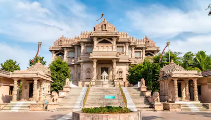
Ajmer is home to many Jain temples that showcase the region’s distinct architecture. The most important among them is the Nareli Jain Temple. This enormous marble temple is adorned with intricate carvings that enhance its architectural elements. What makes it interesting is that the main temple which has a massive idol of Guru Adinath Ji. It is surrounded by 24 temples that are dedicated to the Tirthankar’s line. When you climb up to the top of the mountain, it is a sight worth the effort.
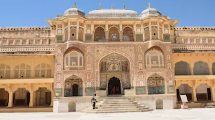
Unlike other military forts, this is a residential fort that was commissioned by Akbar for his son Jahangir. This is where the Haldighati battle was planned and where the emissary of the British government requested the Jahangir to allow the two countries to engage in trade. What is also unique about this fort is that it is situated in the heart of the city and not atop a hill.
The fort has a lot of history attached to it. You can immerse yourself in the past as it is now a museum. The collection includes pictures of important moments, prominent personalities, and artefacts that can be traced back to Mohenjo-Daro. This is one of the places to visit in Ajmer to relive the Mughal era.
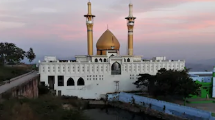
The dargah goes by many names—Ajmer Dargah, Ajmer Sharif Dargah, and Dargah Sharif. It houses the remains of an influential Sufi healer, Khwaja Moinuddin Chishti, from Persia that visited Ajmer. It is a beautiful white marble dargah adorned with Persian inscriptions. What catches your eye from the outside is the marble dome and the 11 arches that surround it.
Inside, the actual tomb is surrounded by a silver platform. Every year it is cleansed with rosewater and sandalwood during the death anniversary of the saint. This is when Ajmer lights up for the Urs festival. Qawwalis are sung in the honour of the saint and kheer is served to the devotees. If you are in town in March, this is one of the places to go to Ajmer.
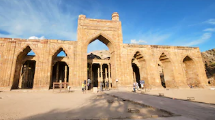
Once upon a time, this used to be a Sanskrit college that was graced by a temple dedicated to Saraswati. Since then, stories have been weaved with the history of this monument. Some say it was a Jain college, or the origin of the name is uncertain.
However, historians agree that Mohammad Ghori ordered Qutbuddin Aibak to build a mosque in two and a half days. A screen wall was constructed so that the Sultan could offer his prayers in privacy. The mosque was completed in 1199; but Qutbuddin Aibak’s successor, Iltumish, constructed a screened wall with arches and inscriptions. Riddled with mystery, this monument is right at the top of the list of Ajmer tourist places.
After a long drive from Jaipur, this lake is the perfect spot to relax and stretch your legs. In 1135, King Anaji Chauhan ordered for the construction of this lake, which was a result of building a dam on Luni River. It is one of India’s largest lake that is teeming with life. However, the water dries up in summer. So, the best time to visit it is after the monsoon season when the lake is full to the brim. The island in the lake adds to its allure. The lake is surrounded by white marble pavilions that Shah Jahan ordered to be built in 1637. They are places around the lake where families can relax. However, the best way to see the lake is to get on a boat.
Ajmer is settled in a valley in the Aravalli Mountain range. So, the best way to get an aerial view of the town is to head to this fort. High up in the mountain, on a cliff, perches the Taragarh Fort or the Star Fort. King Ajaypal Chauhan, the founder of Ajmer, built this fort, which acted as a military base against the Mughals. There were three gateways—Lakshmi Pol, Phuta Darwaza and Gagudi ki Phatak, which are now in shambles. This fort features prominently on the list of Ajmer tourist places.
There a lot more places to visit in Ajmer and the best way to see it all is with SOTC who offer great packages and deals for Ajmer trips.