
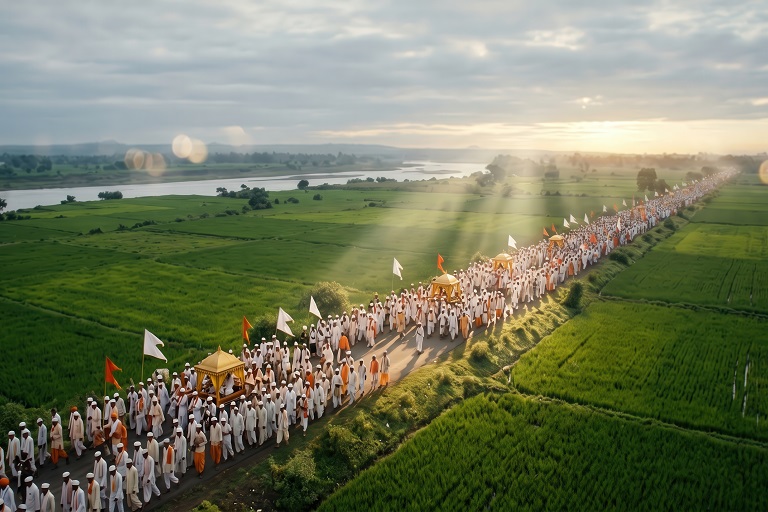
The Pandharpur Wari is one of those journeys that begin long before the first step is taken. Hundreds of thousands of devotees across Maharashtra set out on foot each year, walking toward the temple town of Pandharpur on the banks of the Bhima River. For those who witness this procession from the roadside, or walk within it, the experience belongs to a category that ordinary travel rarely reaches.
Ashadi Ekadashi falls on the eleventh day of the bright fortnight in the Hindu month of Ashadha, placing it in late June or early July each year. In 2026, this sacred day arrives on the 25th of July, and the weeks leading up to it see Maharashtra’s roads and rural paths fill with pilgrims moving in one direction.
What the Day Actually Means
The word Ekadashi refers to the eleventh lunar day. It holds deep significance in the Vaishnava tradition across India. It draws devoted pilgrims and curious travellers alike, many of whom plan their journeys specifically around this day through religious tour packages.
- Ashadi Ekadashi importance is rooted in its connection to Lord Vitthal, a form of Lord Vishnu.
- Devotees hold that observing this day through fasting, prayer, and pilgrimage carries a depth of spiritual meaning.
- The Ashadi Ekadashi meaning is not confined to ritual. At its heart, it is about turning away from distraction and standing before the divine with an open and unhurried mind.
- For the Warkari community, the sect of devotees most closely associated with this tradition, Ekadashi is not simply a marked date. It is the point toward which an entire spiritual practice moves, one built on devotion, walking, and the company of fellow pilgrims.
The Wari, Walking as Worship
The Ashadi Ekadashi Pandharpur pilgrimage, known simply as the Wari, is among the oldest continuous traditions in Maharashtra.
- Devotees called Warkaris travel in large processions called dindis, covering hundreds of kilometres on foot over several weeks to arrive in Pandharpur in time for Ekadashi.
- The two most revered processions carry the padukas, sacred footwear, of two of Maharashtra’s most beloved saint-poets: Sant Dnyaneshwar from Alandi, and Sant Tukaram from Dehu.
- The scale of the Wari is striking, but what stays with you is not the numbers. It is the quality of what moves through those processions.
- The dindis pass through villages and open fields singing abhangas, devotional compositions by the Warkari saints, without pause, through heat and rain alike.
- Those who walk within a dindi often say that after a point, the distinction between the walking and the singing dissolves, and what remains is simply the act of moving forward together.
The Rituals Observed on Ekadashi
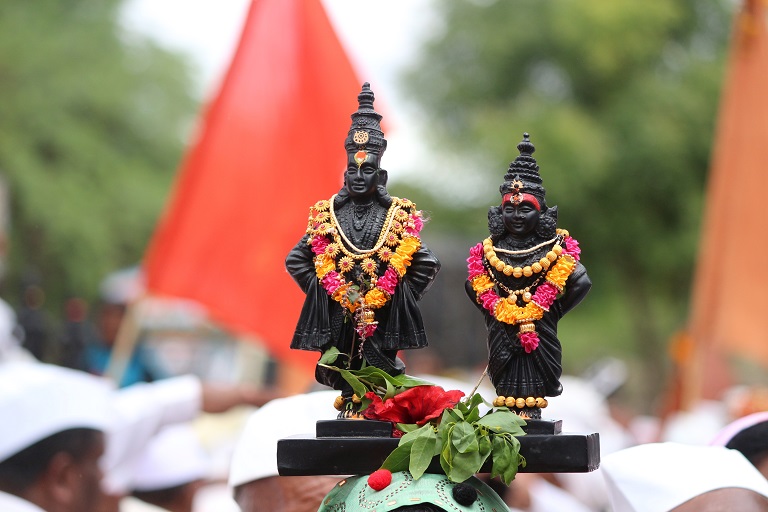
Ashadi Ekadashi significance is observed through a series of rituals that begin well before dawn. Devotees take a ritual bath in the Bhima River, called the Chandrabhaga, at Pandharpur, before joining the queue for darshan at the Vitthal-Rukmini temple.
- Fasting is maintained through the entire day; most Warkaris abstain from grains entirely and consume only fruits or water. The fast concludes the following morning on Dwadashi, the twelfth day, with a simple meal taken after prayer.
- On Ekadashi itself, the temple at Pandharpur sees its largest footfall of the year. The queue for darshan can stretch for many hours, and yet devotees move through it without restlessness.
- There is a particular quality to the atmosphere inside the temple precincts on this day, not the festive energy that marks many large religious gatherings, but something quieter and more sustained.
- People arrive having already given a great deal of themselves to reach this point, and that effort shows in the way they wait.
The Saint-Poets Behind the Tradition
Ashadi Ekadashi cannot be fully appreciated without some understanding of the Warkari saints who shaped it.
- Figures like Sant Dnyaneshwar, Sant Tukaram, Sant Namdev, and Sant Eknath composed their devotional poetry in Marathi, not Sanskrit, deliberately choosing the language that ordinary people spoke and understood.
- Their abhangas addressed love for Vitthal, the irrelevance of caste before the divine, and the quiet dignity of a simple life lived honestly.
- These verses are still sung today in the same form they were composed centuries ago. Hearing them rise from a moving dindi in the early morning, with green fields on either side and the road stretching ahead, carries a feeling that is not easy to set aside once experienced.
- It is the sound of something kept alive with care across many generations, and it communicates directly to anyone willing to listen.
Coming to Pandharpur as a Visitor
Pandharpur falls in Solapur district, which is well-connected by rail and road from both Pune and Mumbai. This makes it a natural anchor point for spiritual journey tour packages that wind through Maharashtra’s most revered pilgrimage destinations.
- Accommodation inside Pandharpur is limited; dharmashalas and pilgrim rest houses handle most of the demand, and booking well in advance is necessary for the days around Ekadashi.
- Visitors who are not part of the Warkari tradition are welcome to observe and attend public areas of the temple complex. Approaching the occasion with quiet respect and unhurried curiosity is all that is asked.
- Maharashtra holds far more than this single occasion, and Ashadi Ekadashi pairs naturally within a wider tour of the state’s spiritual and cultural heritage. Pandharpur can be combined with Shirdi, Trimbakeshwar, Solapur’s own historic sites, or the extraordinary caves of Ajanta and Ellora.
Wrapping Up
SOTC’s Maharashtra tour packages are planned around exactly these kinds of combinations, with itineraries that account for festival dates and travel logistics without leaving the details to chance. For those whose primary interest is devotion and heritage, religious tour packages and spiritual journey tour packages offer curated routes through Maharashtra and beyond, covering pilgrimage sites, temple towns, and sacred rivers within a single, well-considered journey.
The Wari does not ask much of the traveller who comes to witness it. It only asks that you arrive with enough patience to be present, and those who do rarely leave unchanged.