
There is one day each year when Paris feels entirely different from every other day. The streets fill before sunrise, the sky turns bright with colour long after midnight, and an entire nation pauses to remember a moment that changed the course of its history. Bastille Day in France falls on the 14th of July, and if you happen to be in Paris when it arrives, the city will leave a mark on you that is difficult to put into words.
This is not simply a public holiday. It is a deeply observed national occasion, and understanding what it means and how the city moves around it will help you experience it fully rather than simply pass through it.
What the Day Commemorates
The 14th of July, 1789, marks the storming of the Bastille fortress in Paris, a prison that had come to represent royal authority and the suppression of ordinary people.
- Its fall became the turning point of the French Revolution and is now remembered as the founding moment of the French Republic.
- France’s national day carries that weight quietly but unmistakably in the way it is observed. There are no loud declarations or commercial overtones. The tone is proud, reflective, and genuinely communal.
- Understanding this history makes the celebrations far more meaningful for a visitor. What you are watching is not a performance arranged for tourists; it is a country marking the moment it chose a different future for itself.
The Military Parade on the Champs-Élysées
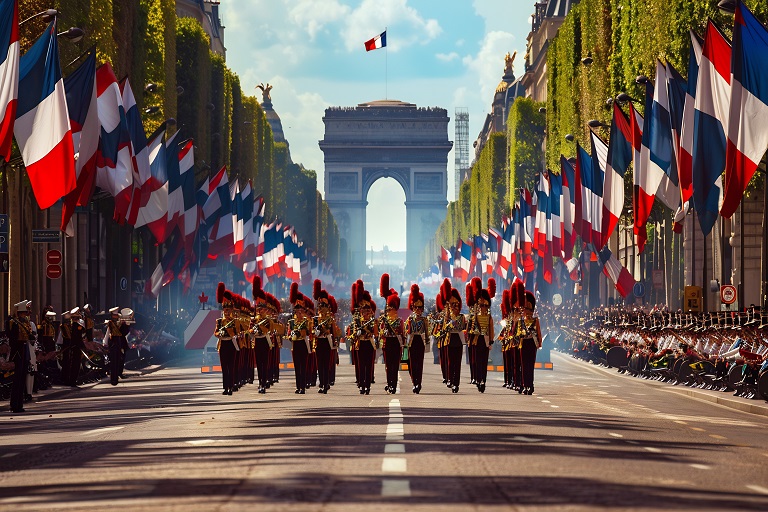
The morning of Bastille Day Paris belongs entirely to the military parade on the Avenue des Champs-Élysées.
- The procession moves from the Arc de Triomphe toward the Place de la Concorde and includes military regiments, armoured vehicles, and a flyover by the Patrouille de France, the country’s precision aerobatic display team, whose aircraft leave trails of red, white, and blue smoke across the sky.
- Arriving early is essential if you want a clear view. Public access areas along the avenue fill up well before the parade begins, and the best positions go to those who arrive at least two hours ahead.
- The area around the Tuileries Garden offers some of the better vantage points further along the route and tends to be slightly less crowded than the stretch nearest the Arc de Triomphe.
Fireworks at the Eiffel Tower
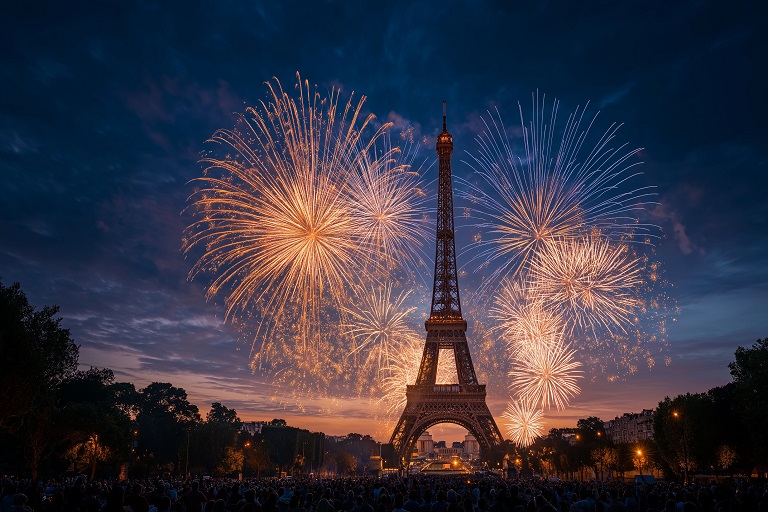
The evening of France’s independence day closes with a fireworks display launched from the Eiffel Tower.
- It is one of the largest pyrotechnic displays in Europe and is accompanied by a live musical programme broadcast across the city.
- The Champ de Mars, the long green park that stretches out from the tower’s base, is where most people gather to watch, and it fills to capacity well before dark.
- Entry to the Champ de Mars is free but managed; security checks are in place, and large bags are not permitted.
- Arriving early gives you a reasonable chance of finding a comfortable spot before the crowds become difficult to move through.
- The display itself begins late, so the wait is long, but the atmosphere during those hours is part of the experience: live music, picnics laid out across the grass, and the tower lit up in gold against the dark sky.
The Bals des Pompiers
One of the lesser-known but most genuinely Parisian traditions of Bastille holiday in France is the Bals des Pompiers, open-air dances hosted by fire stations across the city.
- The tradition dates back over a century and invites the public into fire station courtyards for music, dancing, and drinks through the night.
- These gatherings are free to attend and require no reservations. They tend to draw a mix of locals and visitors and carry the kind of easy, generous atmosphere that is harder to find in Paris during the busier tourist months.
- Checking the Paris fire brigade’s official listings in advance will help you locate the nearest station hosting a Bal on either night.
Getting Around the City
France tourism offices and travel advisors consistently flag the 14th of July as one of the most logistically demanding days to roam around Paris. It’s something worth factoring in when comparing Paris tour packages, since how your itinerary is structured on Bastille Day can make or break the experience.
- Several major roads are closed from early morning for the parade, and public transport operates on a modified schedule.
- The Metro runs extended hours through the night to manage the volume of people leaving the fireworks, but carriages are extremely crowded during peak departure times.
- Walking between viewing areas is often the most practical option during the day, particularly within the central arrondissements.
- Comfortable shoes, a small bag, and early starts will serve you considerably better than any other strategy on this day.
Practical Tips for Visiting
A few things worth keeping in mind before you travel:
- Book accommodation well in advance, Paris fills quickly in mid-July.
- Carry identification, as security presence across the city increases significantly on and around the 14th.
- Most museums and several shops remain closed on France national day, so plan indoor activities for the days around it rather than on the day itself.
- The weather in Paris in mid-July is generally warm and dry, but evenings can cool down once the sun sets; a light layer is worth carrying.
Planning Your Trip
France tourism rewards those who plan carefully, especially around major events. The 14th of July comes within the broader summer travel season, which means flights, trains, and accommodation across the country are in high demand from late June through August. Booking two to three months ahead is standard practice for this window.
Wrapping Up
If you are considering a wider trip that takes in Paris alongside other parts of France, SOTC’s France tour packages and Paris tour packages offer structured itineraries that account for seasonal timing and include the kind of local guidance that makes navigating a major event like Bastille Day considerably easier. Travelling independently is entirely manageable, but a well-planned package removes the logistical pressure and allows you to focus on the experience rather than the coordination around it.