
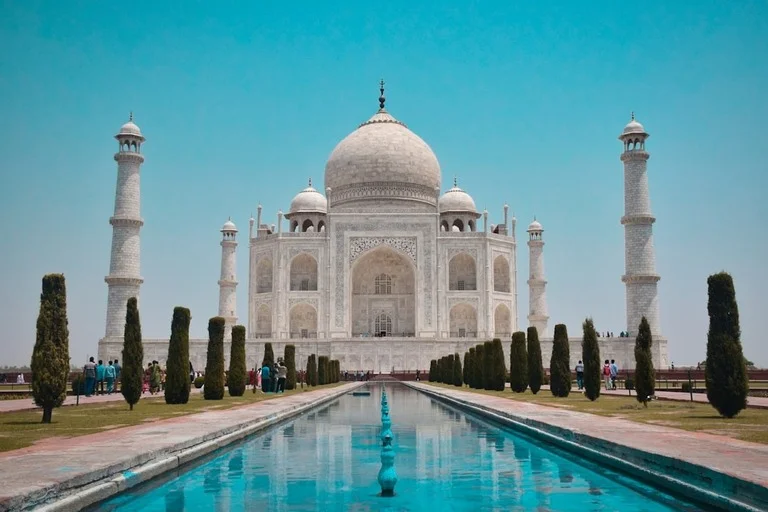
The Taj Mahal, Colosseum, Eiffel Tower, Sagrada Família, Sydney Opera House, Burj Khalifa, Hagia Sophia, Empire State Building, Great Pyramid of Giza and St Basil’s Cathedral are widely recognised for architecture that reflects different periods, cultures and design ideas. Together, they show how buildings can become symbols of the places around them.
Looking at the most famous buildings in the world is also a way to understand how architecture changes with materials, beliefs, technology and society. Some were created for worship or remembrance, while others represent civic life, engineering ambition or modern city growth. Their importance also lies in how people experience space, structure and history through them.
Taj Mahal, Agra
The Taj Mahal brings together symmetry, gardens, domes, arches and decorative craftsmanship in a composition that feels balanced from every viewpoint. Its marble surfaces respond to changing daylight, while the central structure, gateways and landscape work as one visual arrangement.
For travellers looking at iconic landmarks around the world, the Taj Mahal embodies India’s architectural identity. Its Mughal design draws attention to proportion and fine detail without making either feel separate from the whole. Travellers planning time in the city can also consider Agra travel packages when organising their broader journey.
Colosseum, Rome
The Colosseum reflects the scale, planning and structural thinking associated with ancient Roman public architecture. Its layered arches, repeated openings and circular form create a powerful exterior, while the interior reveals how movement, gathering and spectacle influenced the building’s design.
Among the most iconic buildings in the world, the Colosseum continues to shape how travellers imagine ancient Rome. The structure also shows how architecture can survive in an altered form and still communicate the character of an earlier civilisation. Those arranging a longer stay in the Italian capital may look at Rome trip packages to connect the monument with the city’s wider architectural character.
Eiffel Tower, Paris
The Eiffel Tower changed the visual language of monumental architecture by making its metal framework part of the design rather than hiding it behind masonry. The open lattice structure feels light despite its imposing form, and the curved supports create a recognisable silhouette of Paris.
Its place among the world’s most iconic buildings comes from the way engineering and visual identity meet in a single structure. It also represents a period when new construction methods were reshaping ideas about what monumental design could look like. Travellers exploring the French capital through Paris tour packages can place the tower within a much wider architectural landscape.
Sagrada Família, Barcelona
Sagrada Família stands apart for an architectural language that combines religious symbolism, natural forms, sculptural detail and unusual geometry. Its façades and interiors invite close observation, as surfaces, columns, openings and decorative elements appear to grow into one another rather than follow a simple, conventional pattern.
For people interested in famous buildings worldwide, the basilica shows how personal design philosophy can influence an entire building. The relationship between structure and ornament is central, with neither treated as an afterthought. Light also plays a central role inside, changing the atmosphere as it passes through the coloured glass and moves across the branching columns.
Sydney Opera House, Sydney
The sequence of shell-like roof forms beside the harbour gives the Sydney Opera House its distinctive identity. Its design responds strongly to its waterfront setting, so the building is often experienced as part of the surrounding landscape rather than as an isolated object.
Its sculptural profile has helped it become a familiar, famous structure in the world, particularly in discussions of modern public architecture. The building shows how an unconventional roof form can define a cultural venue. Travellers planning a Sydney tour can also observe how the structure relates visually to the harbour, surrounding public spaces and nearby city architecture.
Burj Khalifa, Dubai
Burj Khalifa represents a very different architectural era, shaped by vertical growth, advanced engineering and the desire to create distinctive city skylines. Its tapering profile becomes narrower as it rises, giving the tower a strong vertical rhythm without relying on a simple rectangular form.
When discussing world-famous architecture, Burj Khalifa often enters the conversation because its design is closely tied to contemporary Dubai. The building also illustrates how modern towers combine architecture and urban identity. Travellers using Dubai holiday packages may notice how the tower acts as a visual reference point within the wider cityscape.
Hagia Sophia, Istanbul
Hagia Sophia reflects layers of architectural and cultural history within the same monumental space. Its large central dome, supporting arches, galleries and richly finished interiors create a sense of scale while also revealing changes that occurred as the building’s religious and civic role evolved.
Within architectural discussions, Hagia Sophia is significant because it allows different periods to remain visible rather than completely separating them. The building allows visitors to read history through structure, decoration and spatial organisation. Its interior is particularly striking for the relationship between the central dome and the open volume beneath it, which creates a feeling of height and continuity across the main space.
Empire State Building, New York
The Empire State Building represents the vertical character of twentieth-century New York and the development of the modern skyscraper. Its stepped profile, strong vertical lines and restrained ornament gives the tower a clear silhouette while reflecting the Art Deco design language associated with its period.
It remains part of conversations about major iconic buildings around the world because people closely link its architecture with the image of Manhattan. Rather than relying solely on height, the design uses proportion and setbacks to create a sense of visual movement towards the top. Its presence also demonstrates how a single building can become closely connected with the identity of a dense urban skyline.
Great Pyramid of Giza, Egypt
The Great Pyramid of Giza shows how simple geometry can create extraordinary architectural presence. Its broad base, rising triangular faces and carefully controlled form give it a visual clarity that remains powerful even without elaborate exterior decoration.
As a famous ancient structure in the world, the pyramid reflects the relationship between architecture, belief and royal authority in ancient Egypt. Its form also demonstrates how monumental design communicates permanence through mass, proportion and repetition.
The strength of the design comes from its basic shape and the scale at which that geometry meets the desert landscape.
St Basil’s Cathedral, Moscow
St Basil’s Cathedral is known for its composition of towers, domes, patterns and colours, which creates a highly distinctive silhouette. Instead of presenting a single dominant volume, the structure brings several forms together, giving the exterior a layered and almost rhythmic quality.
It adds another visual language to the iconic structures in the world, showing how religious architecture can rely on colour, ornament and varied roof forms to establish identity.
The building’s appearance differs sharply from the clean geometry of a pyramid or the exposed metalwork of the Eiffel Tower, yet each demonstrates how architectural character can become inseparable from the city or culture associated with it.
What Makes a Building Architecturally Iconic
A building does not become memorable through scale alone. The structures that remain visually distinctive usually combine design, context, cultural meaning and a strong relationship with their surroundings.
Several qualities often shape how people respond to world-famous architecture:
- A silhouette or form that can be recognised easily
- Design choices that reflect the period and place of construction
- Materials used in a way that supports the overall architectural idea
- Interior and exterior spaces that feel connected rather than unrelated
- A meaningful relationship with the surrounding street, landscape or skyline
- Details that reward closer observation instead of relying only on first impressions
These qualities can appear in very different ways. Some buildings depend on symmetry and controlled proportion, while others are memorable because they challenge familiar forms. What matters is how consistently the architectural idea is carried through the structure.
Why These Buildings Continue to Matter
Architecture becomes more meaningful when a building can be read as part of a larger social and cultural story. A monument may reveal religious traditions, construction knowledge, changing tastes or the ambitions of the city that developed around it.
The most famous buildings in the world span very different architectural periods, yet they remain connected by their ability to make design feel memorable. Seeing them in person can reveal elements photographs flatten, including scale, texture, light and the relationship between a structure and its surroundings.
Final Thoughts
A single style does not define the world’s most iconic buildings. Their value comes from the different ways architecture can respond to purpose, culture, materials and place. The Taj Mahal uses symmetry and detail, the Colosseum expresses Roman public design, the Eiffel Tower foregrounds metal engineering, and the Sydney Opera House turns a cultural venue into a sculptural waterfront form.
From ancient monuments to modern towers, these famous buildings worldwide show how architecture can shape a destination’s memory. Looking beyond the façade helps reveal why certain structures continue to influence conversations about design, history and the built environment.